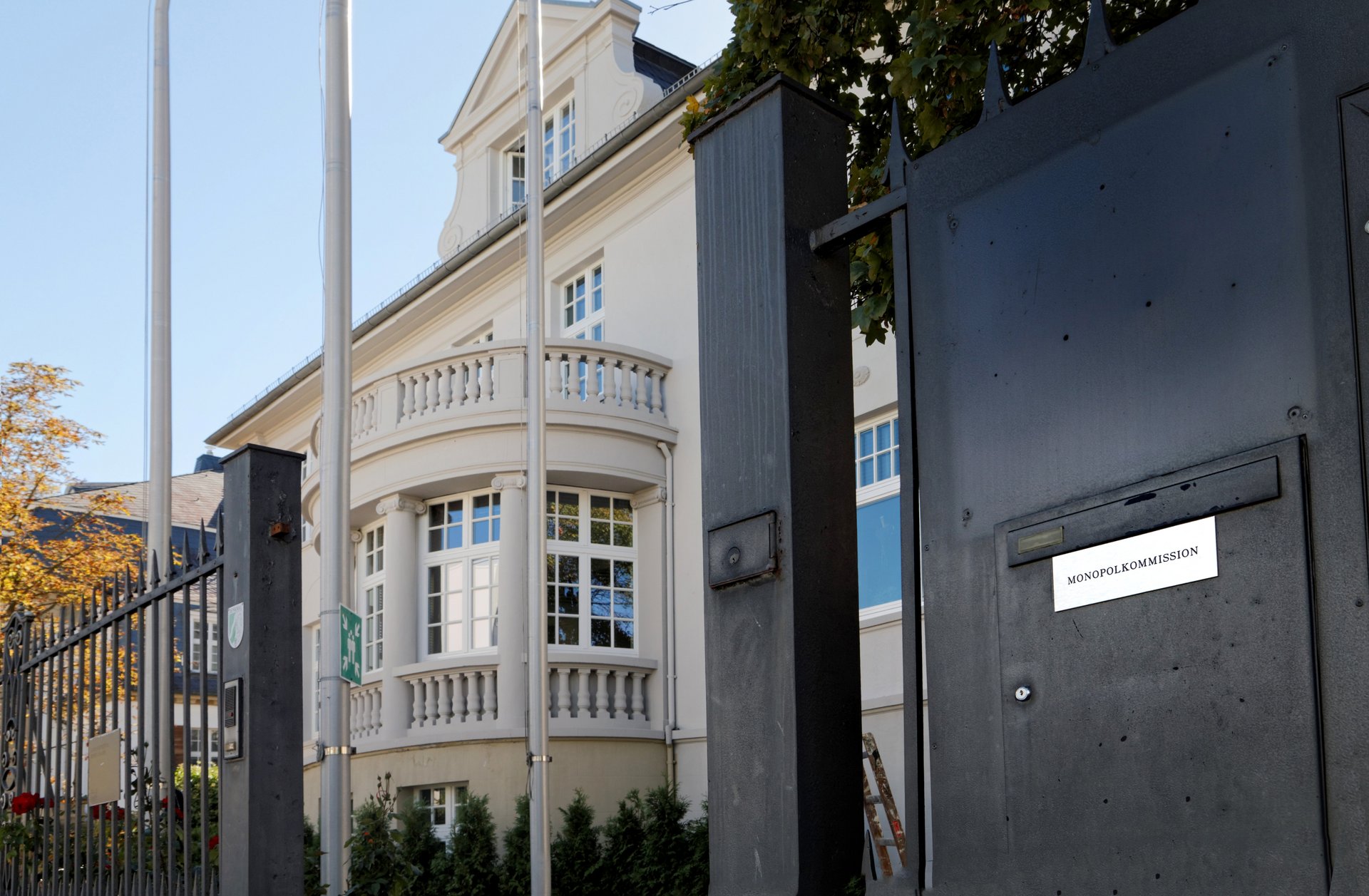


The Monopolies Commission has submitted its twentieth main report to the Federal Minister for Economic Affairs and Energy in accordance with Section 44(1) of the Act against Restraints of Competition (GWB). The report is entitled ‘A Competitive Framework for the Financial Markets’. It covers
- the investigations into corporate concentration and antitrust decision-making practice required under the Commission’s statutory remit.
- The following topics are dealt with in a more concise form: ‘Google, Facebook and Co. – a challenge for competition policy’, ‘Criminalisation of antitrust infringements’, ‘Recent developments in the energy sector’, ‘Competition shortcomings in taxi markets’, ‘Competition in German child and youth welfare’ and ‘The Monopolies Commission’s access to data’.
- In a special chapter, the Monopolies Commission examines municipal economic activity and the growing trend towards remunicipalisation.
- The detailed second special chapter of this main report deals with the topic of ‘Competition in the financial markets’.
The contents in detail:
Google, Facebook and Co. – a challenge for competition policy
Major internet companies such as Google, Facebook and Amazon have increasingly become the subject of public debate in recent times. Among other things, it is suspected that these companies wield a high degree of market power. Their ability to collect and link large amounts of personal data is causing unease in some quarters. The Monopolies Commission is addressing these issues from a competition policy perspective (see also separate press release).
Recent developments in the energy sector
During the reporting period, the Federal Government embarked on a reform of the support scheme under the Renewable Energy Sources Act (EEG). This reform is taking place in parallel with an EU state aid investigation into the previous support regime. The Monopolies Commission recognises the EEG reform as a step in the right direction and advocates a swift transition to the tendering model, which represents a significant improvement on the current support system of fixed feed-in tariffs. The Monopolies Commission also highlights state aid risks that are increasingly coming to the fore. Against this backdrop, it once again advocates the further development of the EEG in line with the quota model it has proposed.
Criminalisation of antitrust infringements
The appropriate design of the antitrust sanctions system is a key focus of the current competition policy debate in Germany and Europe. The Monopolies Commission is examining whether, in the interests of improved competition law enforcement, it is advisable to criminalise particularly serious breaches of competition law, known as ‘hardcore cartels’. In this regard, it considers the criminal prosecution of natural persons responsible for the formation and continuation of cartels to be particularly promising (see also separate press release).
Competition shortfalls in taxi markets
Competition in taxi markets in Germany has so far been insufficiently developed due to licence restrictions in many areas and the general setting of fares by the authorities. The Monopolies Commission’s analysis shows that regulation in its current form cannot be justified on the grounds of ensuring the proper functioning of the taxi industry or providing necessary consumer protection. It therefore recommends lifting the licence restrictions and allowing price competition, initially in the form of price caps. Furthermore, the regulation of hire car services should be amended (see also separate press release).
Competition in German child and youth welfare
In child and youth welfare, the principle of competition is already enshrined in Book VIII of the Social Code through the right of beneficiaries to express their preferences and make choices, and the requirement that youth welfare services be characterised by a diversity of providers, content, methods and working practices. Despite noticeable progress in recent years, the Monopolies Commission sees a need for further improvement so that, in view of limited public funds and simultaneously rising demand, high-quality services in child and youth welfare can continue to be provided cost-effectively in the future. To this end, in the interests of competitive service provision, tax privileges and financial subsidies for established providers that distort competition should be phased out, and opportunities for participation in institutional bodies such as the Youth Welfare Committee should be structured in a provider-neutral manner. The application of public procurement, state aid and competition law, as well as the continuation of the fee reform, can provide important competitive impetus.
Access to data for the Monopolies Commission
One problem that continues to impair the Monopoly Commission’s ability to function stems from the Federal Cartel Office’s refusal to grant the Monopoly Commission, within the framework of its statutory right of access to files, comprehensive access to the individual data held by the Office, e.g. on prices and quantities. The purpose of the right of access to files is to enable the Monopolies Commission to fulfil its statutory duties. These include, in particular, a comprehensive assessment of the antitrust authorities’ practices and the provision of opinions on other competition policy issues. Within this framework, the Monopolies Commission’s statutory right of access to files is comprehensive. The increasing emphasis on economic analysis in the application of competition law by the Federal Cartel Office makes it necessary for the Monopolies Commission to be provided with the data held by the Office for the purposes of its own work. Only in this way can the Monopolies Commission evaluate the Office’s economic arguments through its own analyses and carry out its own empirical investigations into broader competition issues on the basis of its statutory remit. It cannot be in the interests of the Federal Government and the legislative bodies which the Monopolies Commission advises for the Commission’s scope of action to be curtailed to such an extent that it can only fulfil a significant part of its tasks to a limited extent. As the highest federal authority in this regard, the Federal Ministry for Economic Affairs and Energy could ensure a swift clarification of the matter. Should a statutory clarification be deemed preferable, the Monopolies Commission will submit a corresponding legislative proposal.
Corporate Concentration
The reporting on the concentration and interdependence of large undertakings pursuant to Section 44(1), first sentence, of the Act against Restraints of Competition (GWB) is based on the 100 largest undertakings across all economic sectors in the Federal Republic of Germany, identified on the basis of domestic value added. The analyses indicate a general trend towards decreasing concentration in this area. The share of domestic value added accounted for by the large undertakings under consideration fell to 16.0 per cent between 2010 and 2012. In 2000, this figure stood at 20.1 per cent. The share of the ‘100 largest employers’ in domestic employment stood at 13.6 per cent in 2012. It is evident that the process of dismantling the network of personnel links between companies – via individuals holding multiple directorships and links through minority shareholdings – amongst the ‘100 largest’ has been continuing since 1996.
In addition to its investigation into the concentration and interdependence of large German companies, the Monopolies Commission has continued the analysis, begun in its Eighteenth Main Report, of personnel-based corporate interdependence via individuals holding multiple directorships within and between the EU-15 Member States, as well as Norway and Switzerland, which it had begun in its Eighteenth Main Report, and expanded it to include capital-based interlinkages. A total of 5,370 listed companies were examined for the period 2005 to 2011. In the 2011 reporting year, an average of 57.4 per cent of companies were linked to at least one other company through individuals holding multiple directorships. The average degree of interconnection via minority shareholdings is significantly lower: only 17 per cent of the companies observed are linked through capital ties.
Competition law decision-making practice
The most significant change to German merger control was the introduction of the SIEC test as a criterion for prohibiting mergers. The SIEC test replaces the previously applicable market dominance test; nevertheless, the creation or strengthening of a dominant market position remains the standard example of a significant impediment to effective competition. During the Monopolies Commission’s reporting period, the Federal Cartel Office examined only a few cases under the new law. In doing so, the assessment of a dominant position remained the primary focus. The so-called ‘gap case’ – in which a significant impediment to effective competition is established without a dominant position being created or strengthened – has not yet arisen in national competition law practice.
Important decisions under merger control law were made in the cable network sector. The definition of the relevant market in terms of product and geographical scope remains contentious in this sector; in the Monopolies Commission’s view, this definition needs to be adapted more closely to the emerging structural changes in the market. Unlike the Higher Regional Court of Düsseldorf, the Monopolies Commission considers that, under certain conditions, the granting of special termination rights as an ancillary condition of a clearance decision is sufficient to offset the negative effects on competition resulting from a merger of cable network operators.
A key development in European merger control practice concerns the greater integration of theoretical and empirical analyses – so-called quantitative analyses – into decision-making under merger control law. Another important development concerns the increasing invocation of efficiency arguments by the merging parties; however, in no case has the efficiency defence succeeded in fully dispelling the European Commission’s serious competition concerns. Whilst only one transaction was prohibited under Article 8(3) of the Merger Regulation during the previous reporting period, the European Commission issued three prohibitions in 2012 and 2013.
The European Commission pursued two important legislative projects during the reporting period. Firstly, in December 2013, it adopted a package to simplify the merger control procedure. Secondly, the European Commission is seeking to introduce a provision extending its jurisdiction to minority shareholdings without the acquisition of control. In the Monopolies Commission’s view, such a provision should, on the one hand, ensure that all cases raising competition concerns can be addressed. On the other hand, it must be designed in such a way that the additional administrative burden on businesses and competition authorities is kept to a minimum, that there is no over-regulation, and that a high degree of legal certainty is maintained in the future.
An assessment of the Federal Cartel Office’s antitrust enforcement practice is one of the key focuses of this main report. Important antitrust cases from the sectors of drugstore products, railway tracks and points, building materials and the media are discussed. The Monopolkommission also assesses the sometimes controversial procedural practice in the field of online sales. Furthermore, it analyses the application of competition law in areas of intellectual property. The Monopolies Commission once again calls for a reform of the law on fines and administrative offences and comments on the new directive on actions for damages. It regards the hesitant enforcement of competition rules in the health insurance sector as problematic.
Local authority economic activity and the trend towards remunicipalisation
In many places, local authorities are seeking to expand their own economic activities into sectors that have hitherto been organised by the private sector. The Monopolies Commission is examining the economic impact of local authority economic activity in the sectors of water supply, energy, telecommunications and waste disposal, and has drawn up nuanced recommendations for action (see also separate press release).
Competition in the financial markets
The analysis of competitive conditions in the financial markets focuses on the banking markets. It examines systemic distortions of competition in favour of banks and shadow banks caused by implicit state guarantees, structural distortions of competition favouring individual banking groups within the German three-pillar model, as well as current competition issues relating to financial products and transactions (see also separate press release).