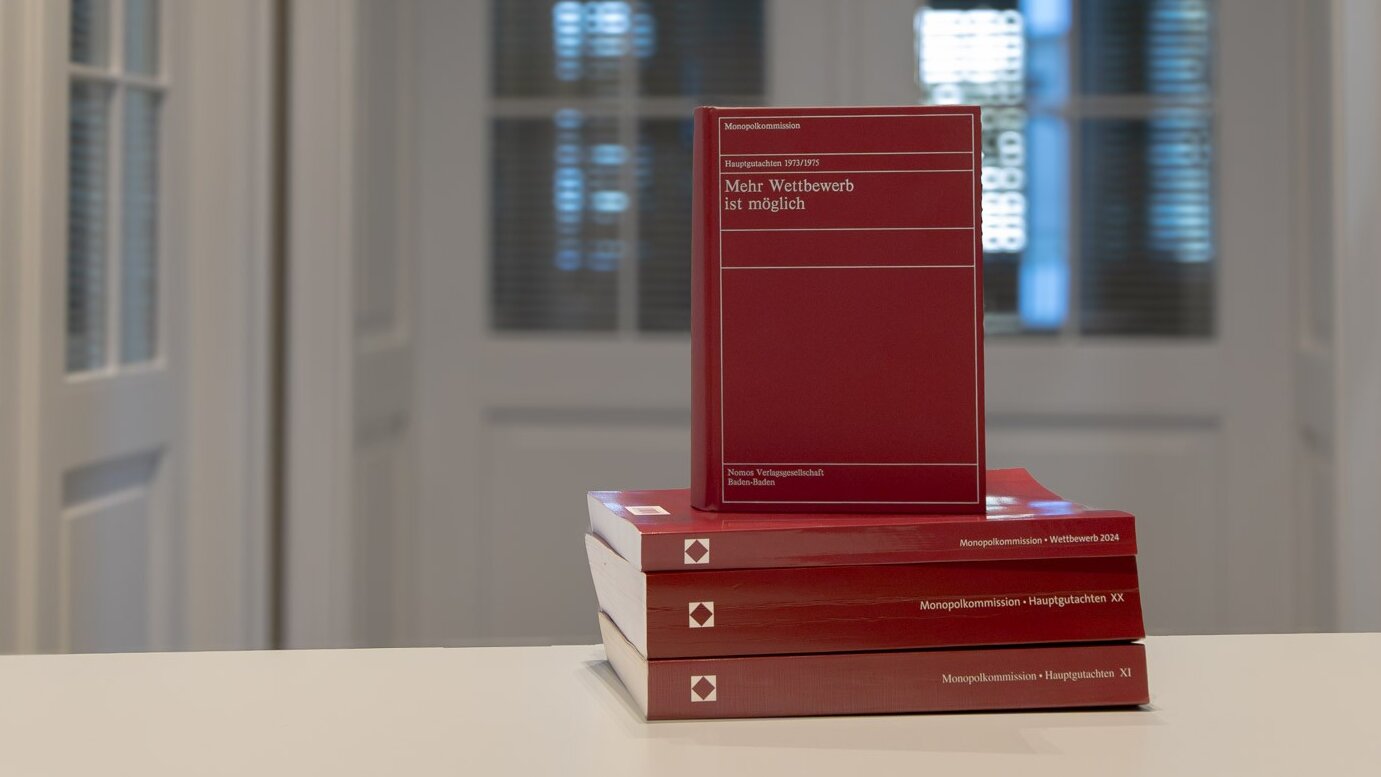

As an independent institution, we advise the Federal Government, Parliament, public authorities and the public on competition, competition law and regulation – in a scientifically sound, independent and accessible manner.

What we actually do
Our remit is to monitor and assess competition in Germany, and to draw recommendations for policy-making from our findings. We analyse where competition is working, where markets are becoming unbalanced, and where the political or regulatory framework can be improved.
At the heart of our work lies the main report. In accordance with Section 44(1) of the Act against Restraints of Competition (GWB), every two years we examine trends in the concentration of business power in Germany, assess the application of competition law and address evolving competition policy issues.
In addition, every two years we produce sectoral reports in the rail, energy, postal and telecommunications sectors. In these, we analyse competitive developments in regulated markets and examine whether the respective regulatory frameworks enable fair market opportunities and effective competition. These tasks are also enshrined in law: Section 62 of the Energy Act (EnWG), Section 78 of the Electricity Market Act (ERegG), Section 121(2) of the Telecommunications Act (TKG) and Section 44 of the Postal Services Act (PostG) in conjunction with Section 121(2) of the Telecommunications Act (TKG).
In addition, we prepare ad hoc special reports and other statements, in particular policy briefs. This is done on our own initiative, on specific instructions from the Federal Government, as part of the ministerial authorisation procedure, and at the request of the Federal Court of Justice.
Our role
Our role is to conduct independent analysis, contextualise developments and formulate recommendations for competition-oriented policy. We are not a regulatory body that conducts proceedings or enforces measures itself. Unlike the Federal Cartel Office, we do not issue binding decisions in antitrust or merger proceedings.
It is precisely in this that our special role within the institutional framework of competition policy lies: we provide guidance, highlight interrelationships and contribute scientifically sound perspectives to political and public debates.
Independence
As an advisory body, we operate free from general political or financial influences – for the public and in the interests of society. We are also independent in our choice of topics and priorities. Our work is guided by evidence-based analysis, methodological rigour and maximum transparency.
Effective competition requires independent institutions. They monitor market developments, assess undesirable trends and provide guidance where economic power is growing or political intervention is altering the conditions of competition.
Why we do this
For us, competition is not an end in itself. We are convinced that effective competition limits power, safeguards freedom and ensures continued prosperity in our society. That is why we are committed to creating the right framework conditions in which the regulatory power of competition can take effect.
FAQ – The Monopolies Commission
-
What is the composition of the Monopolies Commission?
The Monopolies Commission consists of five members, who must possess specialist knowledge and experience in economics or law. They are appointed by the Federal President, on the recommendation of the Federal Government, for a term of four years. The members serve in an honorary capacity and carry out their duties personally and independently. They are supported in their academic work by a team of research assistants.
-
-
How are the Monopolies Commission’s reports drawn up?
The reports are produced in close collaboration between the Commission members and the staff. Staff members with expertise in economics and law lay the analytical groundwork: they carry out research, analyse data and draw up drafts. At regular meetings, the members discuss the content, set priorities and jointly agree on the recommendations.
External perspectives are also incorporated into the analysis process. The Monopolies Commission holds discussions with associations, companies, public authorities, government departments and NGOs in order to take account of different perspectives from academia and practice. All reports are published in full once they have been submitted to the Federal Government. -
Are the Monopolies Commission’s recommendations binding?
No. The Monopolies Commission is an advisory body and does not make binding decisions. Its recommendations are addressed to politicians, public authorities and the public. It is up to those in political office to take them on board and implement them. It is precisely the Monopolies Commission’s independence from decision-making authority that enables it to carry out an unbiased analysis.
-
Why do we need a Monopolies Commission?
Competition is not a state that sustains itself. It requires continuous monitoring, independent assessment and a voice to highlight undesirable developments. The Monopolies Commission fulfils this role: it assesses developments in competition on a sound academic basis, without itself taking sides in proceedings. In this way, it brings an independent perspective to debates on competition policy – one that the authorities cannot provide in this form.