
Jump to content
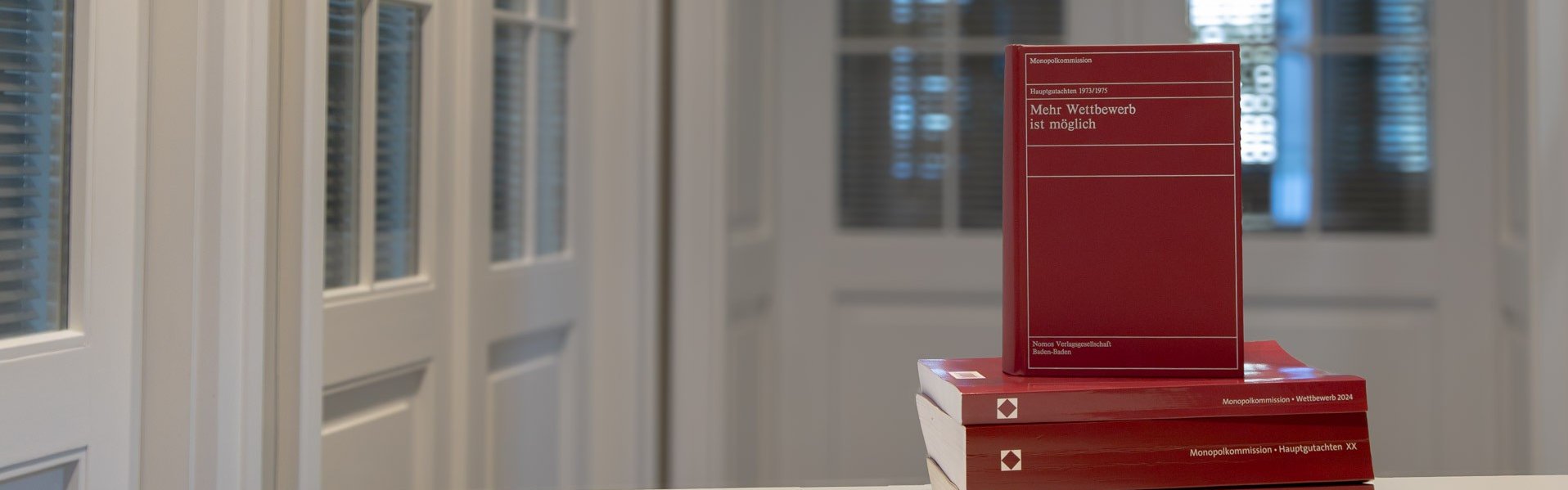
Hauptgutachten der Monopolkommission als Printausgaben übereinander gestapelt

In its main report, “Competition 2022”, the Monopolies Commission sets out recommendations on how adapting the competition framework can contribute to the ecological and digital transformation. It presented its report today to the Federal Minister for Economic Affairs and Climate Action, Dr Robert Habeck.  

The Chair of the Monopolies Commission, Prof. Dr Jürgen Kühling, LL.M., said: “Competition law in Germany is a key pillar for managing the upcoming transformation processes. At the same time, it ensures that market power arising from digitalisation and increasing concentration in individual sectors is limited. The Monopolies Commission also takes a generally positive view of the Ministry for Economic Affairs’ latest proposals to tighten antitrust law. It had already examined the possibility of unbundling independent of abuse back in 2010 and presented recommendations on the conditions for such an instrument, whilst also highlighting its limitations.”  

Specifically, the Monopolies Commission proposes: 

  • that sustainability objectives pursued through cooperation and business combinations be taken into account in antitrust assessments, provided that this brings benefits for consumers, 
  • to supplement the regulation of so-called ‘gatekeepers’ in digital markets, as provided for in the European Digital Markets Act, with national provisions to facilitate injunctive relief and claims for damages,  
  • to respond to the increasing concentration of firms in regulated sectors and rising mark-ups by large companies by strengthening competitive forces in the sectors concerned.  

In many cases, there is no conflict of objectives between competition protection and sustainability. On the contrary, competition is precisely what ensures that companies develop technologies that are both innovative and beneficial to the climate and the environment. However, in cases where climate protection and other sustainability objectives cannot be implemented by companies within a sector acting alone, agreements on the coordinated implementation of higher sustainability standards must be assessed against competition law. Under the so-called ‘efficiency defence’, competition law offers the possibility of balancing competition protection against sustainability objectives, particularly where consumers benefit directly from climate protection measures. A general exemption of sustainability initiatives from competition law, however, is not recommended.  

The Digital Markets Act (DMA), adopted at EU level and due to come into force at the end of 2022, contains a wide range of behavioural obligations for large digital companies to ensure that they do not exploit their economic power at the expense of users. The European Commission may impose sanctions in the event of breaches of the behavioural obligations enshrined in the DMA. 
To make the enforcement of the DMA even more effective, the Monopolies Commission recommends that the German legislature introduce supplementary provisions governing private actions for injunctions and damages. For example, it should be made easier for users to establish the amount of damages by providing, through legislation, for a presumption of damage, as well as provisions for estimating damages and for the accrual of interest on claims for damages.

Jürgen Kühling, Vorsitzender der Monopolkommission

In addition, the legislator should examine the issue of liability on the part of the responsible management. 

“In the manufacturing sector, digital transformation is accompanied by increasing market power, whilst in the services sector it is actually declining,” said the Chair of the Monopolies Commission, Prof. Jürgen Kühling. One indicator of the development of market power is the gap between economic production costs and market prices. In Germany, these so-called price mark-ups rose by just 1.8 per cent in the manufacturing sector between 2008 and 2017, whereas in the services sector they fell by 6 per cent over the same period. Regardless of sector, large companies and those in highly concentrated industries – such as coking and petroleum processing – in particular were already showing significantly rising price mark-ups even before the current crisis. In Germany, however, high mark-ups – particularly in the service sectors – are also associated with high levels of investment in digitalisation and productivity gains. In the manufacturing sector, whilst a correlation between investment in digitalisation and mark-ups can be observed, this is not accompanied by corresponding productivity gains. 

The share of the 100 largest German companies in total economic value added has fallen further, most recently to 14.0% in 2020. Nor have the links between large German companies in terms of personnel and capital increased. By contrast, the indirect interdependence of competitors via shareholdings held by institutional investors, such as BlackRock or Vanguard, remains at a high level in Europe. Overall, almost 80 per cent of economic sectors in Europe are affected by indirect horizontal interdependence. A marked rise in concentration can be observed in the already highly concentrated regulated sectors of the services industry, which include wireless telecommunications, postal services and long-distance passenger rail transport.1 Overall, however, the macroeconomic trend in concentration and market power in Germany remains stable. In view of the increasing potential for concentration driven by the digital transformation and a possible impending economic downturn, developments in Germany should continue to be monitored closely. 

Go directly to the report

Further information for editorial teams

Cookies