
The Monopolies Commission has analysed the first week following the introduction of the fuel rebate. Initial data suggest that, following an initial delay, the tax cut is now largely being passed on to consumers. At the same time, the data suggests that, even before the fuel rebate, fuel prices in Germany were in some cases systematically higher than in France and the UK. This is consistent with ongoing competition issues at the German wholesale level. From 20 May 2026, the Monopolies Commission will publish daily updated analyses on this topic on its website. A detailed policy brief will follow in June 2026.
Initial findings
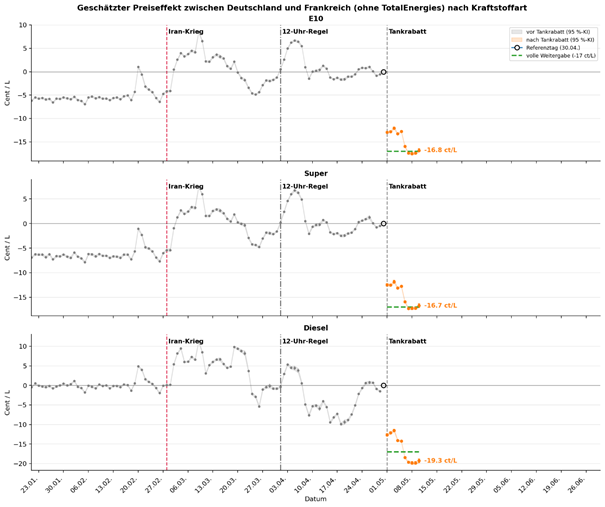
Fuel discount: In the first few days following 1 May, the tax cut of 16.7 cents was initially only partially passed on. However, over the course of the first week, prices began to reflect the full pass-through. A comparison with the UK reveals a similar picture. The considerable media and political pressure is likely to have contributed to this. The findings presented here are based on data from just a few days and are therefore provisional. A reliable assessment will only be possible on the basis of a longer observation period.
12 o’clock rule: In the first week following the introduction of the daily cap on price increases from 1 April, the price gap between Germany and France initially widened significantly. After around a week, however, this difference returned to its previous level. It is still too early to make a definitive assessment of the regulation.
Outbreak of war and market structure: The data also show that, following the outbreak of the war in Iran at the end of February, fuel prices in Germany rose more sharply than in France and the UK. This is consistent with the structural competition problems at the German wholesale level, which the Monopolies Commission has already highlighted. The fact that the petrol station discount has largely been passed on to consumers does not contradict this: despite a high degree of concentration, the petrol station market remains the most competitive part of the value chain. The findings suggest that the disproportionate price rise occurred primarily at the wholesale level, whilst the fuel discount has since been largely passed on at the retail level. The Federal Cartel Office is also investigating these issues as part of its sector inquiry under Section 32f of the German Act against Restraints of Competition (GWB).
Classification
The pattern observed is consistent with markets characterised by limited competition and corresponds to the so-called ‘rockets-and-feathers’ phenomenon: prices often rise rapidly in times of crisis, but fall more slowly when pressure eases. Although the findings to date suggest that the fuel rebate is now largely being passed on to consumers, the higher prices in Germany compared with France and the UK indicate that structural competition problems persist. Regardless of this, the fuel rebate must be assessed critically as a whole. From the Monopolies Commission’s perspective, there are three main reasons against extending this measure: the high fiscal costs, the socially unequal distribution of the relief, and the fact that a tax cut does not resolve structural competition problems. The Monopolies Commission will expand on this preliminary assessment in its June Policy Brief, based on further data.
Methodological note
The Monopolies Commission compares daily price trends in Germany with those in France and the UK. France serves as the primary control group, whilst the UK serves as an additional benchmark market. We exclude Total petrol stations from the French comparison: Total has introduced a self-imposed price cap in recent weeks, which would distort the comparability of the data.