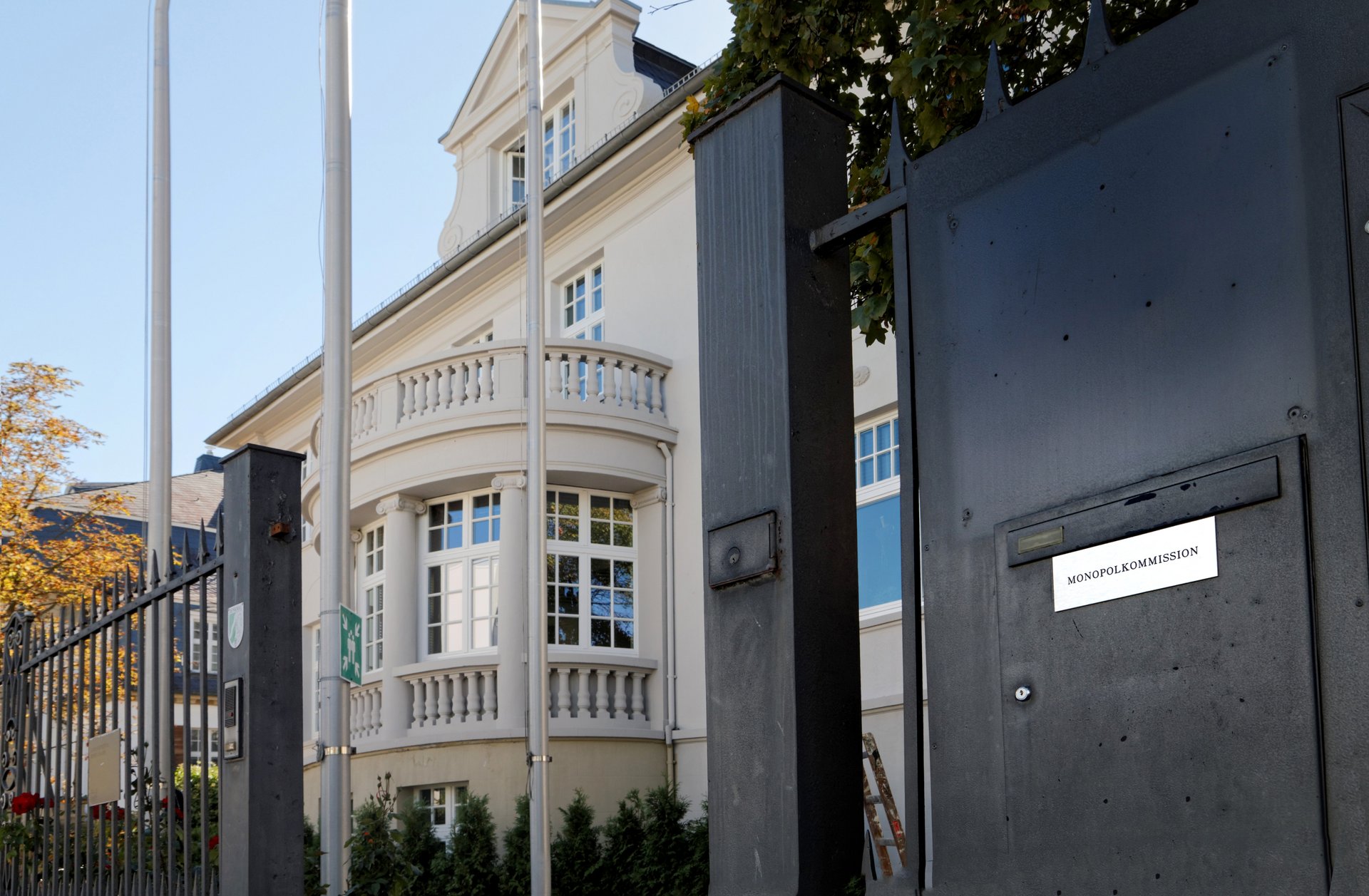


The Monopolies Commission today submitted its opinion to the Federal Minister for Economic Affairs and Energy as part of the Miba/Zollern ministerial authorisation procedure. In it, it recommends that ministerial authorisation should not be granted. In the Monopolies Commission’s view, the public interest grounds put forward by the applicants do not outweigh the restriction of competition identified by the Federal Cartel Office.
The Austrian company Miba AG and the German company Zollern GmbH & Co. KG intend to merge their plain bearing activities into a joint venture, in which Miba is to hold a 74.9 per cent stake and Zollern a 25.1 per cent stake. The Federal Cartel Office had prohibited the merger on 17 January 2019 on the grounds that it would lead to a significant impairment of effective competition in the market for plain bearings with large bore diameters. The companies involved subsequently submitted an application for ministerial authorisation on 18 February 2019.
The Federal Minister for Economic Affairs may grant ministerial authorisation if the benefits to the public interest arising from the merger outweigh the restriction of competition identified by the Federal Cartel Office. However, an exemption can only be granted if there are recognised benefits to the public interest, these are of considerable weight and, furthermore, are specifically demonstrated. In the present case, the Monopolies Commission considers that these conditions are not met.
Although the Monopolies Commission considers the quantitative impact of the restriction on competition to be minor, given the low turnover volume of the relevant market in question, it does see significant qualitative effects on competition. The undertakings involved achieve high combined market shares, which are significantly above the thresholds at which the Act against Restraints of Competition presumes that an undertaking holds a dominant position. Miba and Zollern BHW, a subsidiary of Zollern GmbH & Co. KG, are major competitors from the perspective of buyers of plain bearings. The merger would give the joint venture scope to raise prices. Prices can be increased if customers have no economically viable alternative source of supply. This is the case here because switching suppliers is a lengthy and costly process due to the necessary testing procedures required to qualify a new supplier.
In the Monopolies Commission’s view, grounds of public interest are only admissible if they have a domestic connection, i.e. if they represent benefits to the Federal Republic of Germany or the public interest in Germany. In doing so, it contradicts the applicants, who argue that benefits to the public interest arising additionally within the EU or in an EU Member State outside Germany must be taken into account in the ministerial authorisation procedure. The necessity of a domestic connection follows simply from the fact that the scope of the Act against Restraints of Competition (GWB) and the sphere of competence of the Federal Minister for Economic Affairs are limited to the territory of the Federal Republic of Germany. Another argument against taking into account public interest benefits outside Germany is that the Federal Government, as a constitutional institution, is solely accountable to the German public. However, the inclusion of European public interest considerations in the Minister’s assessment could result in the disadvantages arising in Germany as a consequence of the merger – in the form of higher prices, poorer quality or less innovation – being offset by benefits arising in other European countries.
The applicants base their arguments primarily on the preservation of technological know-how and innovation potential for future domestic applications, such as the use of plain bearings in wind turbines. In this regard, the Monopolies Commission notes that the preservation of know-how can only constitute a public interest benefit if it is of particularly high value to society and does not benefit the applicants alone. This condition could, for example, be met if the know-how were to make a significant contribution to the continuation and development of university research. However, the Monopolies Commission’s investigations have revealed that the existing know-how does not have such a significant spillover effect. Nor have the investigations confirmed that the synergies associated with the merger, arising from the combination of the participating companies’ know-how, are what make the development of the proposed future applications possible in the first place.
In the Monopolies Commission’s view, any strengthening of international competitiveness resulting from the merger should only be taken into account in the ministerial authorisation procedure if it is accompanied by benefits to the public interest within Germany. This could, for example, be the case if the merger leads to economies of scale and scope that enable the undertaking to participate on a long-term basis in markets outside Germany or that open up access to foreign markets in the first place. The applicants have not sufficiently substantiated how the merger would improve competitiveness in the markets in question, nor to what extent this improvement would be accompanied by benefits to the public interest within Germany. Both Zollern BHW and Miba are already active on international markets.
Nor, in the Monopolies Commission’s view, is the merger in Germany’s defence policy interests. Whilst there is a public interest in preserving or strengthening industries relevant to national defence, However, it is not clear that the plain bearings produced by the companies involved constitute key national technologies for the German defence industry. Nor is it apparent that the production of plain bearings must be based in Germany in order for defence equipment vital to national defence to be produced there.
The applicants argue that the proposed merger could, in the long term, safeguard Zollern BHW’s two German sites as well as a large number of the 450 jobs in total. In the present case, however, the high standards required to demonstrate this public interest have not been met. Experience shows that mergers are generally not suitable for securing jobs at risk in the long term. Nor is the public interest in full employment to be equated with the interest in preserving jobs within a specific company. The Monopolies Commission considers it likely that, should ministerial authorisation be refused, Zollern BHW would be sold to an alternative purchaser who would likewise preserve the sites and jobs, at least in part. Furthermore, it cannot be ruled out that Zollern BHW, whilst retaining its sites, will continue to be run independently by its existing shareholders. Finally, given the current positive labour market trends, the Monopolies Commission assumes that the employees of Zollern BHW – even in the unlikely event that the production sites were to be closed down – would have good prospects of finding new employment on the labour market in the short to medium term.