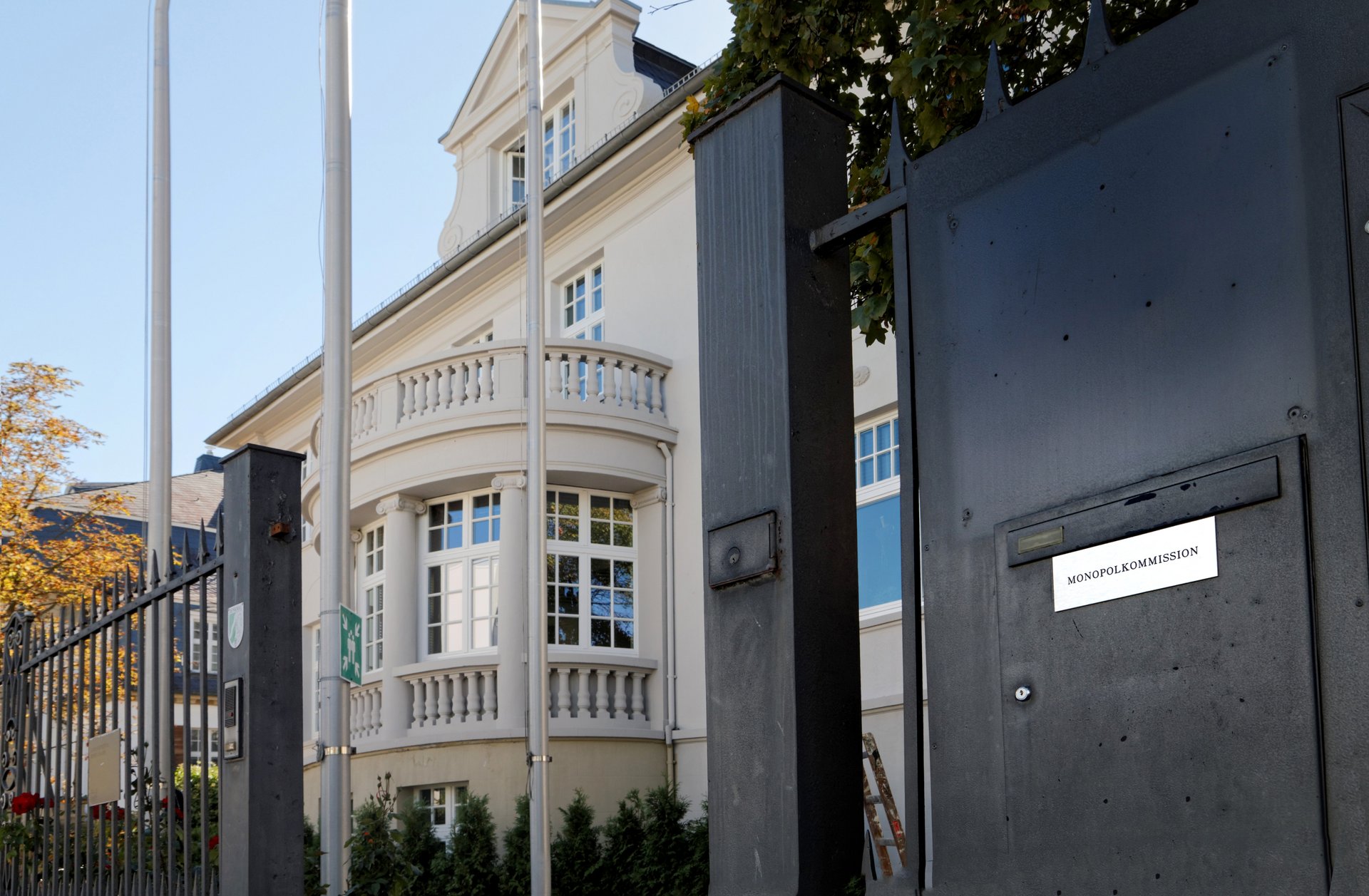


The Monopolies Commission has submitted its Sixteenth Main Report (Biennial Report) to the Federal Minister for Economic Affairs and Technology in accordance with Section 44(1) of the Act against Restraints of Competition (GWB). The report is entitled “More competition in the services sector too!” The services sector continues to be characterised by significant growth and even greater potential. Accordingly, the Monopolies Commission recommends that government economic policy should facilitate greater competition in these areas.
In addition to the statutory analyses of the current state and development of business concentration and antitrust decision-making practice, the report contains an introductory chapter on current competition policy issues and two special chapters on regulatory issues relating to the digitalisation of broadcasting and the regulation of the liberal professions.
In the introductory chapter, the Monopolies Commission discusses the issue of the duty of confidentiality under Section 46(3) of the Act against Restraints of Competition (GWB) when assessing applications for ministerial authorisation under Section 42 of the GWB. It also addresses the amendment to the Energy Industry Act, which provides the basis for the regulation of the grid-based energy sector. Furthermore, it examines the regulatory issues associated with the further development of internet telephony (Voice over IP). The Monopolies Commission has issued recommendations on the partial privatisation of Deutsche Flugsicherung GmbH envisaged by the Federal Government. The issue of merger control under media law has attracted particular public attention in the context of the proposed merger between the ProSiebenSat.1 Group and Axel Springer AG. The Federal Constitutional Court’s most recent ruling on the Crafts and Trades Regulation Act fundamentally called into question the requirement for the ‘Großer Befähigungsnachweis’ (master craftsman’s certificate) as a prerequisite for practising a trade on a self-employed basis. In the final section of the introductory chapter, the Monopolies Commission calls on the political authorities to improve the database used for the statistical recording of concentrations within corporate groups and submits a draft bill to this end.
Voice over IP
The Monopolies Commission advocates a cautious approach to the regulation of internet telephony (Voice over IP). This is primarily because the service is still under development and it is currently impossible to predict whether, and if so which, of the associated business models will be viable in the long term. The key prerequisite for the use of Voice over IP is broadband internet access, which in Germany continues to be provided primarily via digital subscriber line (DSL). The practice by access network operators of bundling DSL with conventional analogue or ISDN connections hinders the development of internet telephony and should be overcome. To enable alternative providers to offer DSL connections independently of the leased local loop, Deutsche Telekom AG should be obliged to provide so-called bitstream access. In order to avoid distortions of competition to the detriment of infrastructure-based providers of conventional fixed-line telephony, the costs of the local access network must also be taken into account when regulating charges for bitstream access. Insofar as Voice over IP qualifies as a publicly available telephone service, there is an obligation to provide a free emergency call facility. Insofar as it is not yet technically possible for emergency calls to simultaneously transmit information about the caller’s location, this requirement should be waived in order to avoid creating a barrier to market entry for internet telephony.
Privatisation of air traffic control
The Monopolies Commission takes a critical view of the partial privatisation of Deutsche Flugsicherung GmbH (DFS) and the new Air Traffic Control Act (FSG). The draft legislation adopted by the Bundestag and the Bundesrat to implement the privatisation only partially meets the high standards required of air traffic control. Potential areas of concern include the politically driven timetable for privatisation, the establishment and staffing of the Federal Supervisory Authority for Air Traffic Control (BAF), and the future ownership structure of a substantially partially privatised DFS. The Monopolies Commission is of the opinion that the privatisation should be implemented in a manner commensurate with the importance of air traffic control as the ‘air traffic police’. In its view, a heterogeneous ownership structure should therefore be adopted as part of a phased model for implementing the privatisation. Under this model, the Federal Government would initially remain the majority shareholder in DFS, with the remaining stake being sold to air traffic control users – primarily airlines and airports – which have a vested interest in the smooth functioning of air traffic control. Following the successful establishment of the BAF, other private investors should then, in a second stage, be allowed to acquire a stake in DFS via the capital market. The Federal Government’s stake would be reduced to the minimum level stipulated by law. In the view of the Monopolies Commission, this two-stage process is both necessary and appropriate given the importance of air traffic control.
Merger control and media regulation
In the summer of 2005, it was announced that Axel Springer AG and ProSiebenSat.1 Media AG were to be merged. Under German competition law (GWB), this proposed merger was to be assessed by the Federal Cartel Office, and under the provisions of the German Interstate Broadcasting Treaty (RStV), by the Commission for the Investigation of Concentration in the Media Sector (KEK). Under the provisions of the RStV, the KEK is tasked with safeguarding diversity of opinion in the media sector.
The media regulator’s assessment of the proposed Springer/ProSiebenSat.1 merger has shown that the attempt to quantitatively measure the influence exerted on public opinion through various media must be regarded as having failed. The Monopolies Commission considers its concerns, which it expressed in July 2005 in a statement to the KEK regarding the interpretation and application of Section 26(2) of the RStV, to have been confirmed, and, with regard to the control of concentration in the media sector, opposes a specific assessment of the flow of opinion and the prevailing influence on public opinion in individual cases.
Trade Regulations
In its decision of 5 December 2005, the Federal Constitutional Court (3rd Chamber of the First Senate), going beyond the specific case at hand, expressed fundamental doubts as to the constitutionality of the regulations on the compulsory master craftsman’s certificate that were in force until 2003. The existing administrative practice regarding the licensing of self-employed craftspeople has for years been at odds with the requirements of the highest court’s case law, which calls for the generous licensing of self-employed craftspeople without a master craftsman’s certificate.
The ruling of 5 December 2005 makes it clear that the Federal Constitutional Court actually considers the compulsory master craftsman’s certificate to be unconstitutional. The consequence of this would be the abolition of the compulsory master craftsman’s certificate, as has long been demanded by the Monopolies Commission. Otherwise, the current practice is likely to continue, whereby exemptions are granted sparingly and tradespeople without a master craftsman’s certificate are kept out of the market under pressure from their established competitors, who, with the help of chambers of crafts and district trades associations, rigorously ‘crack down on undeclared workers’.
The Monopolies Commission continues to advocate the complete abolition of the compulsory master craftsman’s certificate as a prerequisite for market access in the skilled trades. The circumstances in the skilled trades sector do not justify any special economic status and therefore do not justify any legal exceptions within the Trade Regulation Act. The degree of risk involved in individual trades, as well as the need to safeguard training provision, also do not provide sufficient justification for regulating market access in the skilled trades sector. However, in the Monopolies Commission’s view, there is no reason not to permit the master craftsman’s examination on a voluntary basis as a mark of quality for the public and to promote competition within the skilled trades.
Concentration statistics
In accordance with its statutory mandate, the Monopolies Commission also reports in its Sixteenth Main Report on the development of corporate concentration in Germany. Unfortunately, it remains only possible to a limited extent to take corporate groups and other business groupings adequately into account. In those sub-sectors of the manufacturing industry for which the Federal Statistical Office has compiled data, it is apparent – as was already the case in the Fifteenth Main Report – that, when corporate groups are taken into account, concentration in many economic sectors is up to about three times higher than when one considers only companies – as defined in official statistics – as the smallest legal units. The Federal Statistical Office declined to extend the analysis to other economic sectors. On the basis of its own, more comprehensive data on the control relationships existing between companies, the Monopolies Commission also provides information on the distribution of parent and subsidiary companies in Germany. There remains an imbalance between the old and new federal states in this regard: in the new federal states, there are relatively few parent companies and relatively many subsidiaries. To this extent, the extent of independent entrepreneurial activity in the new federal states is overestimated by the business statistics.
The Monopolies Commission is also once again examining the role of the hundred largest companies in Germany. The share of these companies in economic activity in Germany appears to be systematically declining, both in terms of value added and employment. However, this does not reflect a relative loss of importance, but rather the increasing outsourcing of activities abroad. The relative size of these companies and their share of domestic value added are diverging to the extent that these companies are having production carried out abroad.
Competition issues in the broadcasting sector
The media sector is undergoing change at various levels. Many companies in the media value chain are merging or expanding their range of services; in Brussels, consideration is being given to the new Television Directive and the special status of public service broadcasters in the Member States; and in Germany, there is debate over how to handle television licence fees. In a special chapter, the Monopolies Commission attempts to systematically summarise the latest developments in this sector and examine them critically from a competition policy perspective.
In order to promote the development of an efficient and internationally competitive private media industry, the allocation of responsibilities within the dual broadcasting system should be reconsidered. The Monopolies Commission recommends clarifying the remit entrusted to the public service sector and transposing the European Commission’s recommendations on public service broadcasting into national law. Furthermore, the broadcasting licence fee should be contingent upon an appropriate assessment of programme quality and the fulfilment of the broadcaster’s remit. The Monopolies Commission considers public service broadcasting licence fees to constitute state aid within the meaning of European law. Accordingly, there is a need to provide the European Commission with a comprehensive justification for these fees and their use.
Digitalisation has alleviated the key competition issue of spectrum scarcity in the broadcasting sector, opening up new opportunities for players across the media value chain in terms of both the provision and consumption of broadcasting services. To promote the development of new business models in the media sector, the Monopolies Commission advises exercising restraint when it comes to regulatory intervention. Interventionist market measures always carry the risk of either causing distortions of competition in dynamic markets or limiting investment incentives and entrepreneurial initiative.
Liberal professions
A further special chapter deals with the liberal professions. In this chapter, the Monopolies Commission has addressed the issue of competition-restricting regulations for this professional group in general, whilst also examining individual liberal professions—namely solicitors, pharmacists and freelance architects and engineers—in detail as examples.
The Monopolies Commission takes a particularly critical view of the restriction of price competition through the setting of binding minimum prices. This applies in particular to lawyers’ fees for appearing in court and to the minimum rates set out in the Schedule of Fees for Architects and Engineers. In the Monopolies Commission’s view, the arguments put forward to justify these minimum prices are not convincing. Minimum prices are not a suitable means of, for example, ensuring the quality of professional work or guaranteeing access to the legal system. Furthermore, it is highly doubtful whether binding fee scales are permissible under European law. However, the fee scales in question should not be abolished, but should continue to exist as non-binding reference rates – they would only apply insofar as nothing else was agreed upon when the contract was awarded.
The Monopolies Commission also sees scope for greater competition in a number of other regulations. For instance, the scope of the Legal Advice Act should be reduced to a core area. Graduates in business law and lawyers who have passed the first state examination should be authorised to provide out-of-court legal advice. The Monopolies Commission also advocates the legalisation of contingency fees. The regulations governing law firms incorporated as limited companies should be liberalised. In particular, subject to accompanying regulations, persons other than lawyers, tax advisers and auditors should also be permitted to hold equity interests in such companies.
With regard to pharmacists, the Monopolies Commission recommends the general authorisation of pharmacy chains and the lifting of the ban on third-party ownership. Furthermore, pharmacies should be able to be integrated into other retail premises. For certain medicines, it should be examined whether they still need to be available only through pharmacies. In addition, the Monopol Commission makes proposals on how greater price competition can be facilitated in the pharmacy sector as well.
On a personal note
With the expiry of his second term of office, Commission member Hellwig stepped down from the Monopolies Commission on 30 June 2006. The appointment of his successor is still being finalised. Commission member Preusker’s term of office also ended on 30 June 2006. It is intended to reappoint him for a further term. The terms of office of the remaining three commission members end on 30 June 2008.