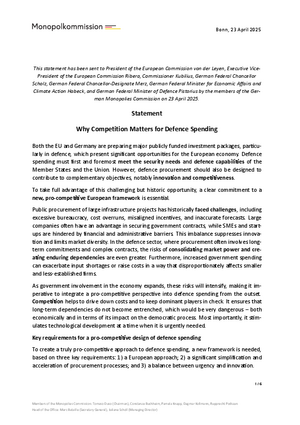

With regard to the European Union’s ‘Readiness 2030’ objective, the Monopolies Commission is calling for an urgent transformation of defence procurement in order to remove bureaucratic hurdles whilst ensuring competition. With planned defence investments totalling 800 billion euros, Europe cannot afford to stifle innovation and delay the development of innovative technologies through cumbersome procurement processes. The German government’s independent advisory body is calling for a reduction in bureaucracy, the prioritisation of comprehensive European solutions and the creation of fast-track procedures for innovative technologies – all whilst adhering to robust competition safeguards.

Competition is not merely a luxury in times of peace – it is the fundamental principle of the European economic order and, at the same time, the driving force behind innovation and efficiency, including in defence procurement. Without a robust competitive framework that opens up opportunities for start-ups and innovation in strategically important key technologies such as AI, cyber security and unmanned systems, we run the risk of creating rigid monopolies that will hamper our security solutions for decades to come.
In its opinion, the Monopolies Commission sets out specific recommendations for a competition-friendly procurement policy based on three key requirements:
- Greater European coordination and interoperability
Member States must align and coordinate their procurement strategies in order to pool demand, generate economies of scale and prevent fragmentation of the European defence industry. Defence systems should be designed with interoperability as a fundamental requirement rather than an afterthought, in order to enable seamless coordination of the armed forces across the EU. - Simplifying and accelerating procurement
procedures Current procurement processes often favour established contractors and exclude innovative solutions. By introducing flexible, innovation-friendly formats, procurement authorities can harness the agility and creativity of small and medium-sized enterprises (SMEs). This would diversify the supplier base and accelerate technological progress. - A balance between urgency and innovation
Although acute security requirements necessitate cooperation with tried-and-tested suppliers, the Commission recommends the parallel implementation of dual-sourcing strategies and innovation programmes that promote competition. This two-pronged approach ensures both short-term operational readiness and long-term technological superiority.
The Monopolies Commission further emphasises that the allocation of public funds must remain firmly anchored in the rule of law. Regulations on public procurement and state aid should be simplified, but not abolished. Regulatory authorities must be able to effectively identify and combat anti-competitive behaviour, corruption and collusion – without hindering innovation.
Transparent procedures are essential to ensure that the defence sector can operate in an innovative, efficient and publicly accountable manner.